
Tuesday, August 7, 2012
Outdated response to Dawn of the Dead (2004)


Monday, August 6, 2012
Introduction to Rape in Horror and Suspense: Why Are We Talking About This?
I am a woman with a complex history of sexual assault who consumes a vast amount of horror and suspense media. Which is to say I am a lover of problematic things. I have a relationship with 2009's Last House on the Left that frankly resembles drug use. I am a total sucker for "get the girl" films like Taken and Spartan. Even as I roll my eyes at the dumb trope, in which a man gets the godlike moral priviledge to commit ANY act of violence he likes because (gasp) a (young, white, and most likely blonde) woman's sexual purity is at stake, I still enjoy myself. Even with drama, most of the movies I choose to view multiple times have some thread of sexual trauma woven somewhere into the narrative. That's no coincidence.
For me, being a survivor of sexual assault feels like I have an invisible appendage: some sort of third foot just made to be stepped on. It is not something I carry like a burden; it is a part of my body, the narrative of my life, and my minute-to-minute existence. Outside a handful of social situations, to disclose a history, an incident, or even to express a fear of unwanted sexual attention, is considered impolite at best, and at worst is met with hostility, denial, and the threat of repeated trauma. Is it any wonder I am drawn to depictions of survivors? I do not feel seen. I am looking, in culture, for some sort of mirror.
For the most part I avoid the kind of PTSD that can emerge from viewing horror and suspense movies that include rape because, a) they desensitize me, at least in the short term, and b) I assume that they will be triggering, infuriating, that they will take something that is a part of my story and they will tell it wrong. That is what works for me. This is not a movie guide for survivors. I do not speak for all survivors. This is a space designated for the fact that I simply can't enjoy problematic things without naming them.
Surviving sexual violence, no matter how easy it is to minimize, makes you an expert in your own oppression. It is a short and sometimes necessary jump from that stance, to beginning to critically analyze the culture surrounding this oppression. My own personal journey to confront and cope with the lasting effects has led me to schools, prisons, theaters, nonprofits, informal groups, and all sorts of institutions to confer with other survivors, other experts. These are my credentials: I have learned how to talk about rape and aftermath in a million different settings, and most importantly, I have learned the exceptional art of listening to someone whose life has been fragmented by some moments or hours or years of violence inflicted upon them, violence irrevocably tied to sex in some way.
In the following weeks, I am going to talk about several aspects of movies and TV shows that utilize rape as a part of the plot. I will talk about rape revenge movies like Sweet Karma, I Spit on Your Grave(s), and the aforementioned "get the girl" action flicks, in which rape is the justification for further violence. I will talk about the pleasure of viewing a magical world in which the rape of a woman or a child is met with action rather than inaction and further victimization; a mystical, far-off world in which perpetrators are invariably held accountable, and some movies like Teeth and Hard Candy where it's even a little fun. I will talk about my dissatisfaction with representations of and responses to survivor characters. I will surely take a moment to take to task Stephen Baldwin for Loving the Bad Man, a really exceptionally Conservative Christian film in which a rape survivor chooses to carry her attacker's baby, and then starts visiting him in jail (alternate title: Stockholm Syndrome: the Musical). I will talk about what I want to see more of, and what we can just retire and start replacing with something more interesting, or realistic, or both. If you are lucky, I will even talk about the exceptional art of listening to a survivor.
Up next: Part 1: in which I look at rape as the ultimate moral pass for a violent rampage. In the meantime, I'm going to go and pet my cats.
For me, being a survivor of sexual assault feels like I have an invisible appendage: some sort of third foot just made to be stepped on. It is not something I carry like a burden; it is a part of my body, the narrative of my life, and my minute-to-minute existence. Outside a handful of social situations, to disclose a history, an incident, or even to express a fear of unwanted sexual attention, is considered impolite at best, and at worst is met with hostility, denial, and the threat of repeated trauma. Is it any wonder I am drawn to depictions of survivors? I do not feel seen. I am looking, in culture, for some sort of mirror.
For the most part I avoid the kind of PTSD that can emerge from viewing horror and suspense movies that include rape because, a) they desensitize me, at least in the short term, and b) I assume that they will be triggering, infuriating, that they will take something that is a part of my story and they will tell it wrong. That is what works for me. This is not a movie guide for survivors. I do not speak for all survivors. This is a space designated for the fact that I simply can't enjoy problematic things without naming them.
Surviving sexual violence, no matter how easy it is to minimize, makes you an expert in your own oppression. It is a short and sometimes necessary jump from that stance, to beginning to critically analyze the culture surrounding this oppression. My own personal journey to confront and cope with the lasting effects has led me to schools, prisons, theaters, nonprofits, informal groups, and all sorts of institutions to confer with other survivors, other experts. These are my credentials: I have learned how to talk about rape and aftermath in a million different settings, and most importantly, I have learned the exceptional art of listening to someone whose life has been fragmented by some moments or hours or years of violence inflicted upon them, violence irrevocably tied to sex in some way.
In the following weeks, I am going to talk about several aspects of movies and TV shows that utilize rape as a part of the plot. I will talk about rape revenge movies like Sweet Karma, I Spit on Your Grave(s), and the aforementioned "get the girl" action flicks, in which rape is the justification for further violence. I will talk about the pleasure of viewing a magical world in which the rape of a woman or a child is met with action rather than inaction and further victimization; a mystical, far-off world in which perpetrators are invariably held accountable, and some movies like Teeth and Hard Candy where it's even a little fun. I will talk about my dissatisfaction with representations of and responses to survivor characters. I will surely take a moment to take to task Stephen Baldwin for Loving the Bad Man, a really exceptionally Conservative Christian film in which a rape survivor chooses to carry her attacker's baby, and then starts visiting him in jail (alternate title: Stockholm Syndrome: the Musical). I will talk about what I want to see more of, and what we can just retire and start replacing with something more interesting, or realistic, or both. If you are lucky, I will even talk about the exceptional art of listening to a survivor.
Up next: Part 1: in which I look at rape as the ultimate moral pass for a violent rampage. In the meantime, I'm going to go and pet my cats.
Thursday, July 26, 2012
Snidely Enjoying The Innkeepers and On the Inside
The Inkeepers (2011): Immaculately creepy haunted inn story that revels in the scare. A little more character development than average, with a rapport between the snide slacker main characters that nestles the scary ghost shit neatly between their most earnest flaws.
Alternate movie title: The Ghost Who Stole Everyone's Towels.
Side Note: Why are ghosts these days always so corps-y? I'm going to start a kickstarter project to raise money for ghosts to become certified in ghost first aid. (Bonus: first aid could lead to ghost sex, which the religious right is bound to find immoral.)
On the Inside (2011): I was sucked in by the cast, as I often am when it comes to technically and emotionally unremarkable movies. However, On the Inside did give me Nick Stahl just as I like him: a haunted, somewhat grotesque manchild.
Olivia Wilde also had a chance to shine as brightly as possible in a role that could have been about a thousand times more interesting or realistic. As with Wilde's character, the institution staff is not quite generic but still uninteresting--everything but the lone journey of Stahl's character seems to be written in a sort of shorthand void of complexity. The main characters, mostly inmates at a mixed security institution, are either psychos or victims (guess which one Wilde gets to play!). If the film has any point at all, it is to illuminate the nuances between maniacs.
Of course Stahl wins over the lovely Wilde, pretty much over the course of one evening. He does so by acting incredibly standoffish, and then occasionally acting very slightly less standoffish. Then he stops someone from raping her (after, you know, thinking about it for a few minutes), and then he bleeds out and dies. Not the greatest movie, but it is the ultimate first date with Nick Stahl.
 |
| Also props to writer/director Ti West for adding to my "Sara Paxton can't breathe" collage. |
Alternate movie title: The Ghost Who Stole Everyone's Towels.
Side Note: Why are ghosts these days always so corps-y? I'm going to start a kickstarter project to raise money for ghosts to become certified in ghost first aid. (Bonus: first aid could lead to ghost sex, which the religious right is bound to find immoral.)
On the Inside (2011): I was sucked in by the cast, as I often am when it comes to technically and emotionally unremarkable movies. However, On the Inside did give me Nick Stahl just as I like him: a haunted, somewhat grotesque manchild.
 |
| He's just a pro at that. |
 |
| And, apparently, to have Olivia Wilde looking good while getting assaulted. |
Of course Stahl wins over the lovely Wilde, pretty much over the course of one evening. He does so by acting incredibly standoffish, and then occasionally acting very slightly less standoffish. Then he stops someone from raping her (after, you know, thinking about it for a few minutes), and then he bleeds out and dies. Not the greatest movie, but it is the ultimate first date with Nick Stahl.
Monday, July 16, 2012
Three Semi-Recent Horrors, Easy on the Spoilers
Scraping the bottom of the 2010-and-later barrel for a good scare:
And Soon the Darkness (2010): Commercial-grade xenophobic travel horror narrative seemingly designed by people from the US in order to make other people embarrassed to be from the US. Also, did they just use the term "white slavery"? Bad case of remake syndrome. Unremarkable. Pass.
Don't Go into the Woods (2010): Maybe it's the War of the Vincents, maybe it's daddy issues, but some of us stubbornly follow Vincent D'Ononfrio into whatever crap he rolls around in. Take your advice from the first word of the movie's title: Don't. Just don't. Unless and maybe even if you are a D'Ononfrio crap archivist like me, please, I cannot warn you enough: Don't. This is the first feature-length film in which he directs, and I am so sad to report: it is a carbon-copy coeds in the woods horror whodunit, with song. You heard me: with song. Coeds who sing their feelings in indie rock harmony = a vapid musical and a lousy horror move that somehow also manages to be unfunny. (Oh, Vincent, method acting the same crazy guy from Law and Order: CI for ten years has really taken it out of you, hasn't it?)
The Pact: (2012): A ruthlessly understated, tense indie horror flick that adheres to its own supernatural rules and brings a little more to the table. The characters (all unknown actors, with one well-disguised exception) strike a balance between blank enough to be relatable but interesting enough to die. All the severed limbs and evil monster ghosts in the world can't be as frightening as this scoreless, hybrid little gem.
Worth multiple viewings, and integrates the technological more so than the usual "Twenty minutes to explain why the cell phone got lost" sequence. Here, the supernatural is so perfectly and astutely poised in relation to the dysfunctional. I'm going to go ahead and call modern scary classic on this one.
And Soon the Darkness (2010): Commercial-grade xenophobic travel horror narrative seemingly designed by people from the US in order to make other people embarrassed to be from the US. Also, did they just use the term "white slavery"? Bad case of remake syndrome. Unremarkable. Pass.
Don't Go into the Woods (2010): Maybe it's the War of the Vincents, maybe it's daddy issues, but some of us stubbornly follow Vincent D'Ononfrio into whatever crap he rolls around in. Take your advice from the first word of the movie's title: Don't. Just don't. Unless and maybe even if you are a D'Ononfrio crap archivist like me, please, I cannot warn you enough: Don't. This is the first feature-length film in which he directs, and I am so sad to report: it is a carbon-copy coeds in the woods horror whodunit, with song. You heard me: with song. Coeds who sing their feelings in indie rock harmony = a vapid musical and a lousy horror move that somehow also manages to be unfunny. (Oh, Vincent, method acting the same crazy guy from Law and Order: CI for ten years has really taken it out of you, hasn't it?)
The Pact: (2012): A ruthlessly understated, tense indie horror flick that adheres to its own supernatural rules and brings a little more to the table. The characters (all unknown actors, with one well-disguised exception) strike a balance between blank enough to be relatable but interesting enough to die. All the severed limbs and evil monster ghosts in the world can't be as frightening as this scoreless, hybrid little gem.
Worth multiple viewings, and integrates the technological more so than the usual "Twenty minutes to explain why the cell phone got lost" sequence. Here, the supernatural is so perfectly and astutely poised in relation to the dysfunctional. I'm going to go ahead and call modern scary classic on this one.
Saturday, July 7, 2012
Felon (2008): "It could happen to YOU, doughy white middle of the country!"
Whenever I find out about a Val Kilmer movie I haven't heard of before, even that damn FBI whodunit that I solved during the preview, I admit: I do get kind of a movie boner. While he does occasionally choose some unwatchably crappy roles, he has consistently made a standout movie every four or five years, for the past three decades. But friends. I am going to need more than a grain of salt for this one: I am going to need a truckload of coarse, snow-melting salt.
Felon (2008): lured me in with its killer cast of honkies (Kilmer, Stephen Dorff, Sam Shepard) and the appeal of Chris Rock in the obligatory I Do Serious Stuff role. The nature of the movie's setup, in which an adult white property-owning male goes to to jail for defending his family lends the film a smarmy, “It could HAPPEN to YOU, trembling doughy white guy,” vibe. I'm pretty sure that people of color and/or working class people in the Estas Unis are already familiar with the fact that it doesn't even take a violent offense like the one committed by Stephen Dorff's character in order to get irreversibly sucked into the Prison Industrial Complex. (In fact, Chris Rock had a great quote in the Times a few years back, in which he pointed out that the Prison Industrial Complex is a not-so-distant ancestor of slavery.)
So yeah. Thanks, movie: Prison is the times table where our culture multiplies its racial and class-based violence. Did you have anything else for us?
What can a movie set in this context possibly say other than Prison is Bad? Hell, Death Warrant (think Jean-Claude Van Damme at his tawdriest) said that, and I don't think they were particularly trying. In any case, I jotted down a few other possible things we can take away from Felon as I watched:
 |
| Just change the lettering on the jumpsuit, and BAM: Prison movie. |
1. Chris Rock Can Break a Man?
Nah, Oz pretty much proved that you can take Winston from Ghostbusters, put him in the right uniform, and he will convincingly play Gang Chess with the people trusted to his care.
2. Staging Ultimate Fighting Matches in Prison is... Bad?
Ooh, daring move. Well played, movie.
3. Stephen Dorff does an inspired backward push-up?
Ok, ever since Linda Hamilton rocked the incarcerated workout look from Terminator 2, I've been a fan of the art of confined athleticism. Yes, Stephen Dorf in “I worked with my trainer eight hours a day,” mode is moderately hot. But what, they made too many boxing movies that year? C'mon, movie.
4. I'm Spartacus?
Been there, done that.
5. Prison isn't Fun?
See above.
6. Let Val Kilmer be your Spirit Guide?
Not that he didn't play an interesting character, but I'll take Jim Morrison Val Kilmer or even the stripped-down ethos of Spartan Val Kilmer, if we're talking spirit guides who mete out interesting slogans the whole time.
As the movie closed into its last twenty minutes or so, I was ready for a riveting betrayal, or maybe an American History X-style tragedy. Sadly, the story lets the system and the powers that be off the hook, opting instead for a kinder, gentler prison movie. Ultimately the message was (and how to put this delicately?) “It could happen to YOU, trembling white male doughy center of the Estas Unis, but don't worry, because unlike the majority of incarcerated people, when we tell your story, it will be a hero's journey.”
While it was fun to watch Stephen Dorff and Val Kilmer Define Their Masculinity Together in the Cruel, Cruel World, at this point, if you're going to make a movie about prison, PLEASE do some creative or political work. There is just too much racism and rape and capitalism in prisons today to squander another prison set on the same tired bullshit. Seriously, Hollywood, next time you've got a couple million lying around that you want to blow on a prison movie, come to me first. We could put it directly into any number of legitimate and brilliant and struggling nonprofits that address any of the nuances you want to darlingly “expose,” (and many of the ones you don't dare touch).
Verdict: If I want a feel-good prison movie, I'll watch Shawshank Redemption (but probably I won't). If I want pure candy prison action, I'll go back to Death Warrant and watch Jean-Claude Van Damme kill that Aryan maniac three times in one fight. If I want a good “expose the system” humanizing drama, I'll watch Sleepers. If I want to be informed about the horrible conditions of prisons in the US, and the larger issues of the prison industry, I'll watch any of the 200 English-language documentaries that discuss these things. Felon tried to do a little of all of these things, and wound up doing none. Moderately interesting characters notwithstanding, I sentence it to life in the annals of mediocre film history.
Thursday, June 28, 2012
Prometheus (2012) and my Master's Degree in the Alien Franchise
Friends, I hate movie theaters. I hate them with a passion. Every now and then some well-meaning friend will drag me to a movie assuming that I will take a part in the immersive, almost out-of-body experience that most moviegoers seem to enjoy, where I am then treated to approximately ninety minutes of sheer anxiety surrounded by a loud black void. It doesn't matter if the movie is funny, emotionally astute, or violent, or not violent. I. Hate. Movie Theaters.
I hate 3D anything, I hate not getting to pause things when I have to pee (which was how I missed the sex scene in Titanic, which is why I watched that hideous thing twice), I hate the feeling of sitting in front of strangers or having strangers sit in front of me. I hate that I can't be multitasking and my mind is trapped like a small sad frog in the enormous black kettle of my neuroses: the list goes on.
That said, I had a wonderful matinee with my mother the other afternoon. It was my idea, because she is a theater lover, and there were not one but two movies I wanted to see. First I suggested the Avengers, thinking we would share the warmth of a good ol' fashioned Joss Whedon ensemble. Turns out, I kinda missed the bus on that one; it's only at the older theater where there is no parking. So we saw the other movie that I was profoundly excited to see: Alien prequel Prometheus (2012).
A few short takes:
1. As an avid follower of the process of the Alien franchise (but none of that Predator crossover bullshit), I had to ask myself if the actors suffered enough during production.The first Alien was made in a time where regulations regarding health hazards, as well as cruelty to animals and children in the film industry were more... subjective than they are now. At their best, the Alien films inspire a sense of abject claustrophobia, and, while Sigorney never bit the hand that fed her or complained about the slime (so many buckets of slime), the supporting cast, from Veronica Cartwright to Wynona Ryder, have all indicated that this effect is achieved by making the actors suffer; the suspense is achieved with the blood and sweat of the cast. One gets the impression that given the chance to play with bigger, better CGI toys to revisit the mythology of his earlier work, Ridley Scott may have neglected to boil enough child stunt doubles and/or torture enough female actors to make the film truly a part of the series. Was there enough human suffering to be consistent with the previous four films? This remains To Be Determined.
2. Clever casting in Charlize Theron as a Corporo-Fascist mogul, and also, more importantly, the eminently likable Noomi Rapace (aka the Swedish original Girl Who Blah Blah Blahed), who plays a scientist with just enough religion to appeal to people who are afraid of science. There were also some men if the movie, if I recall.
3. The origins! Of the giant, uterine spaceship that impregnates the John Hurt of 1979's original Alien Geiger dropcloth! Fun!
4. It is interesting to note that I watched this film instead of a film written by someone who deserves at least a little credit for crashing the Alien franchise into the ground in 1997: Joss Whedon. Like Val Kilmer Batman and Terminator 3: Judgement Day, Alien Resurrection is the hillbilly cousin of the franchise. If you, dear reader, need to pretend that any or all of these movies were never made, I will understand. (I like to pretend Batman Forever was just what happened when Val Kilmer's character from the Salton Sea gets slipped some bad ecstasy.)
5. So... Of the possible awful scenarios I never wanted to watch Noomi Rapace experience, I can now chalk another off the list: The Horrific Sci-Fi Pregnancy. I will leave Anita Sarkeesian at Feminist Frequency to fill you in on the details of the trend, but perhaps you already feel me when I say ladies, if you ever realize that your life is a sci-fi movie, DO NOT GET FUCKING PREGNANT. It is not going to be fun.
http://www.feministfrequency.com/2011/07/tropes-vs-women-5-the-mystical-pregnancy/
Remember: Practice safe sex, IN SPACE.
I hate 3D anything, I hate not getting to pause things when I have to pee (which was how I missed the sex scene in Titanic, which is why I watched that hideous thing twice), I hate the feeling of sitting in front of strangers or having strangers sit in front of me. I hate that I can't be multitasking and my mind is trapped like a small sad frog in the enormous black kettle of my neuroses: the list goes on.
That said, I had a wonderful matinee with my mother the other afternoon. It was my idea, because she is a theater lover, and there were not one but two movies I wanted to see. First I suggested the Avengers, thinking we would share the warmth of a good ol' fashioned Joss Whedon ensemble. Turns out, I kinda missed the bus on that one; it's only at the older theater where there is no parking. So we saw the other movie that I was profoundly excited to see: Alien prequel Prometheus (2012).
A few short takes:
1. As an avid follower of the process of the Alien franchise (but none of that Predator crossover bullshit), I had to ask myself if the actors suffered enough during production.The first Alien was made in a time where regulations regarding health hazards, as well as cruelty to animals and children in the film industry were more... subjective than they are now. At their best, the Alien films inspire a sense of abject claustrophobia, and, while Sigorney never bit the hand that fed her or complained about the slime (so many buckets of slime), the supporting cast, from Veronica Cartwright to Wynona Ryder, have all indicated that this effect is achieved by making the actors suffer; the suspense is achieved with the blood and sweat of the cast. One gets the impression that given the chance to play with bigger, better CGI toys to revisit the mythology of his earlier work, Ridley Scott may have neglected to boil enough child stunt doubles and/or torture enough female actors to make the film truly a part of the series. Was there enough human suffering to be consistent with the previous four films? This remains To Be Determined.
2. Clever casting in Charlize Theron as a Corporo-Fascist mogul, and also, more importantly, the eminently likable Noomi Rapace (aka the Swedish original Girl Who Blah Blah Blahed), who plays a scientist with just enough religion to appeal to people who are afraid of science. There were also some men if the movie, if I recall.
3. The origins! Of the giant, uterine spaceship that impregnates the John Hurt of 1979's original Alien Geiger dropcloth! Fun!
4. It is interesting to note that I watched this film instead of a film written by someone who deserves at least a little credit for crashing the Alien franchise into the ground in 1997: Joss Whedon. Like Val Kilmer Batman and Terminator 3: Judgement Day, Alien Resurrection is the hillbilly cousin of the franchise. If you, dear reader, need to pretend that any or all of these movies were never made, I will understand. (I like to pretend Batman Forever was just what happened when Val Kilmer's character from the Salton Sea gets slipped some bad ecstasy.)
5. So... Of the possible awful scenarios I never wanted to watch Noomi Rapace experience, I can now chalk another off the list: The Horrific Sci-Fi Pregnancy. I will leave Anita Sarkeesian at Feminist Frequency to fill you in on the details of the trend, but perhaps you already feel me when I say ladies, if you ever realize that your life is a sci-fi movie, DO NOT GET FUCKING PREGNANT. It is not going to be fun.
http://www.feministfrequency.com/2011/07/tropes-vs-women-5-the-mystical-pregnancy/
Remember: Practice safe sex, IN SPACE.
Wednesday, June 20, 2012
Tales of Squalor: The Cell (2000)
Plot: In this installment of the great Battle of the Vinces, JLo wanders through many musicless music video sets in full costume, battling an equally becostumed Vincent D'Ononfrio while Vince Vaughn tries to rescue a woman from a pre-Saw torture chamber.
Lineup:
Jennifer Lopez stars as doe-eyed social worker, Catherine (her last name is apparently in the credits but is
never used, so we shall call her: Catherine), who goes to work every
day and puts on a skintight red scuba suit, which allows her to enter
the mind of a comatose boy, where she appears as herself, wearing
dresses too fancy to for the Oscars. You know, JLo's day job. Later,
she agrees to enter the mind of a comatose serial killer, which looks
like the Modern Art Copyright Infringement Museum, installed in a
leaky, unlit underground warehouse. Also, Catherine is an
accomplished mental health worker who apparently believes
Schizophrenia is a virus (hint: it's not).
Vince Vaughn plays a sensitive, yet
hard-boiled FBI agent called Novak (I think his first name might be
Agent) who is deeply invested and, in some unspecified way, point
person on the D'Ononfrio serial killer case, and who eventually has
to chase Lopez into the misogyny wax museum of the serial killer's
mind, in order to rescue Lopez, and also to strangle out a tepid kiss.
Also features: The pedophile from Happiness as Chief of Scienc-y Exposition, performing almost exclusively from a desk chair. Together with Agitated British Lady, they run mission
control for Red Scuba Suit Technologies: (Possible motto: “Dropping
JLo directly into your psyche since 1998.”)
The Serial Killer: Carl Stargher/Big Seedy White Dude
(think Vincent D'Ononfrio playing Barf from You Can't Say That On
Television, in Hell). The Serial Killer also doubles as the visual
landscape of the film; in other words, a large portion of the film is
located inside his psyche (the aforementioned dank modern art
warehouse/intercut with a semi-graphic scenes from a child abuse
history/and some bugs). Because the setting is expansive, D'Ononfrio plays several
different variations of his character: from the shy and disturbed
adult abuse victim, to the godlike and demonlinke manifestations of
his rapey modern art fantasies. Also at one point he plays a
Victorian Doctor Clown. You see, it's all very Jungian, with
different parts of the psyche represented, which means D'Ononfrio
does not escape the music video format; he is done up as much if not more than J-Lo. He appears in full effects gear, weird fake hair, elaborate costumes
that you can't sit down in and that (one imagines) can only be filmed
from the front because they are held together in the back with clips.
In fact, before his mind becomes the scenery, D'Ononfrio's screen time as
anything other than a doughy white guy in a coma is disappointingly
short; only enough to establish that he is an extremely organized,
disturbed, perverted monster who is about to spend the rest of his
time on earth in a red fitted scuba suit. It is wonderful to watch D'Ononfrio portray a delectable series of monsters.
Chorus: a starter kit of seasoned
actors (all the speaking roles are men, SURPRISE) playing seasoned
federal and state law enforcement officers. Think Red Dragon, and
then remove Harvey Keitel and Ed Norton. An actor that I have always mistaken for the guy who plays The Thing in the Fantastic Four movies has a single awesome line of dialog that I've come to mark in my
notes as a “dudemustachemoment,” although it does not in any way involve a mustache. (For fun, count the number of times in his filmography he is listed as "SWAT team leader.") There is also a doctor who again refers to Schizophrenia as a virus in the film's misguided attempt at
cogency.
Second Chorus (mostly silent, visual
only): bleachy powdered mostly white women/sexualized female corpses.
There are a few conceits we make in
order to properly view this movie. 1: Lopez, or anyone else in the
proper fitted scuba suit (which, in keeping with the tone of the
movie, is borderline Body Worlds grotesque), can be dropped into the
mind of any other person, much like dropping a marble into a glass of
milk. The person's psyche will be semi-intelligible, largely
symbolic, and fairly fluid. 2. Because somebody made The Matrix and
Nightmare On Elm Street (and, I don't know, maybe Inception, I don't
watch or blog or rant about remotely current movies), if you die in
the surrealist world, you also die in the world where your body
lives: the stakes have never been higher, and stuff.
The movie, throwing a bone to pre 9-11 torture
fans, who had not quite developed today's fangs, features several
jump-cuts to this week's Woman in a Fridge, Julia: the killer's last
kidnapped victim, who is trapped in an undisclosed location in a room
that is, over the course of a day or two, filling with water, as she
goes through the seven stages of horror movie death, which include
screaming, getting sprayed with water, praying, screaming, and
also more splashing around and screaming. Whenever the plot gets
laggy, Vince Vaughn lights a cigarette and gives a speech about how
Julia's going to die, like, any fucking minute now, if we don't jump
into comatose Vincent D'Ononfrio's head and, I
don't know, slap him around a little.
Props in this movie go to: Tarsem
Singh, the director, who would go on to make an equally visually
compelling nonlinear narrative, The Fall (2006), an adorable story set in a
hospital about a child invalid and the stories an adult invalid tells
her in order to manipulate her into getting him enough morphine to overdose. The Fall is
perhaps the more recommendable of the two, and where it tries to do
too much, it fails splendidly, and where it incorporates music video
sets and steals from land art and early silent cinema, it does so
lovingly. (The Fall: Way less rape-y, but some problematic depictions of race--don't get me started).
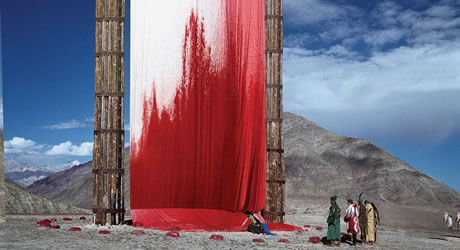 |
| If Christo had incorporated more murder into his landscape art. |
But The Cell is an admirable first
movie. Despite the fact that the law enforcement/exposition scenes
feel alternately clunky and jittery, it is a lush fever dream of a
thriller. Audiences would perhaps benefit from multiple viewings of
the film, which leads me to:
My Squalid Confession: I have probably
watched this movie dozens of times. Despite what we could politely
call the film's poetics of degraded and decomposing women, I LOVE
this movie. I love its fractured narrative, I love its lucid dream
quality, and I even love JLo's performance. This is a movie we could
no doubt place in the “rapey” category of cinema, and not in that
somewhat satisfying way (see: Hard Candy, Teeth). The ending, though
it supplies the obligatory “twist” and could be argued to be
empowering for the female protagonist, leaves much to be desired. (It
also paved the way for a highly unfortunate sequel.) Still, there are
nice moments; a good portion of the film hinges on Catherine's
ability to connect with the small innocent shard left inside the
monstrous man. Her capacity for empathy is what drives the narrative.
The killer is portrayed as someone who more than deserves to die, yet
the film still humanizes him. The attention to detail is
extraordinary, the choppy transitions serve the momentum, and even
when the narrative wanders, the evocative powers of Singh are always
at play. He demonstrates extraordinary control in a film of massive
vision and mixed execution.
Also J-Lo smokes a joint in her
underwear while watching old cartoons, which is pretty much what I do
all day, but with less Pilates and no team of Hair Technicians. But
that's not what I love about The Cell.
I am drawn to repeatedly view certain
movies with graphic content. The Cell is one of a small handful of
movies that, while utterly problematic and most certainly stimulating the absolutely wrong areas of my brain, I will gladly watch into the
ground. It would go into my nuclear bomb shelter with me, or to my
desert island, if you will. It is one of the great Squalid Classics,
and, while it barely passes the Bechdel test, has a mesmerizing and
strong female lead. Where it willingly enters the territory of the
unspeakable, of graphic sexual violence, of violence to children, of
painstakingly overthought abuses to women, and let's not forget some
roaring necrophilia, it doesn't quite ring the 'Sploitation bell.
Perhaps it is because of Catherine's ability to feel, perhaps it is
because she is able to witness, empathize, and object simultaneously
to these unspeakable things. Which leads me to:
Best Scene: There is an entirely too short
moment between Novak and Catherine in which Vaughn (in his best
Wedding Crashers' Sincere Hurt Guy Affect), alludes to a history of
severe childhood sexual and physical abuse. I like that moment for a
number of reasons: It is the best, and perhaps the only tender moment
of connection between the two main protagonists. It debunks the taboo
that male survivors don't exist/aren't allowed to speak about it. It
is set in the film specifically to argue that while nurture makes
monsters of some of us, others are able to overcome their earliest
and most horrific conditioning; a sort of Vincent-Vince nature versus
nurture point-counterpoint. And lastly, despite my reference to the
insincere evocation of empathy utilized by Vaughn in Wedding Crashers
(“We lost a lot of good men out there,” et al.), this moment plays out more realistically. Novak's character is still in some ways defined
by his abuse—he exists only to catch the bad guy, and get the woman
out of the fridge. He has empathy, he even has people skills, but his
tacit reveal to Catherine isn't a play to get under her expensive
high fashion social worker wardrobe. He's not slick. In that moment of disclosure, of
intimacy, he seems to also express desire for her, and in that moment
he fumbles it, botches it completely, accidentally flirting instead
with his partner, who interrupts their conversation.
The part of me that is a survivor and
also a critic wants to see that one moment, that one set of motives, and also the awkwardness of intimacy for the abuse survivor, expanded into a whole movie. Even though The Cell is liberally
peppered with dead and defiled women, here is this one moment where I
feel like everybody got it right: the vulnerability and weird trust that comes with choosing to disclose an abuse history. For all I know, Lopez and Vaughn could have despised
each other, and spent the entire shoot in their respective trailers
ignoring one another (based on most of their scenes together, I think
this is a credible theory). Still, there is something dark and
wonderful in that moment; there is humor, there is communion, there is depth. Oddly
enough, while Lopez does the heavy lifting in terms of emotional
performance, Vaughn gets at something about being a survivor that is
hard to articulate, and incredibly important. A disclosure like that
is an act of trust; it says, “I lived through this,” and “I
live with this,” and “I live this,” all at once. I find it
refreshing, if only because the only other place in film I find these
kinds of conversations is the realm of the After School Special.
This post has been a long time coming,
because The Cell is simultaneously squalid and humanizing. It is sure
to trigger some people who are sexual assault survivors. It probably
also pleases some really gross people. (I know it does both for me.) As for my
personal verdict: when it is not doing interesting things with the
unspeakable, it is still entertaining enough due to its aesthetic to
make me go easy on some of the more interchangeable elements. After
all, the goal is not perfection.
The goal, my friends, is perfect
squalor.
Tuesday, June 19, 2012
Boys Don't Cry (1999)
An incredibly sweet story about two young, naive people falling in love. Wait, this film goes on for another hour? That can't be important.
Monday, June 18, 2012
Sunday, June 3, 2012
The Formats, they are a Changin'
We here at Femmebot Versus Shark have not noticed how the popularity of things that are short and pithy. Although I am still not cool enough to tweet, I do take notes on the movies I watch that wind up as short poems. And so even though we have never taken steps to monetize this blog, because we are probably too foul, we will now discuss individual movies, briefly, as their own entries. It's a leaner, more boiled-down method, Femmebot Versus Shark Lite, if you will. We aim to deliver hard little kernels of truth that don't pop until THEY'RE IN YOUR BRAIN, although [spoiler alert] we do reserve the right to get talky about the portrayal of sexual assault in several intriguing and problematic films in the near future.
Please enjoy, at your leisure, the next sequence of vampire and soldier movies.
Subscribe to:
Posts (Atom)